
Friends of the Emm Brook is currently involved in numerous projects monitoring and recording the astonishing biodiversity of species that can be found throughout the year in and around the Emm Brook and its tributaries.
Kick Sampling
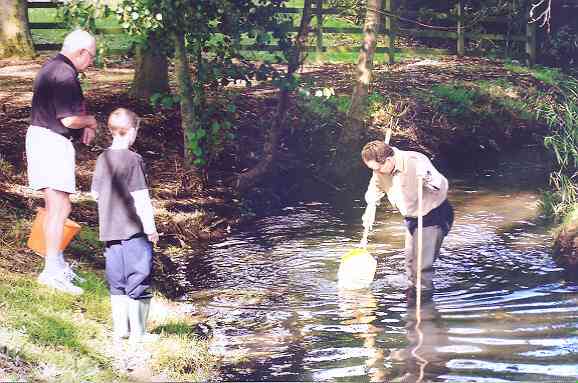
Biologists use the ‘kick sampling’ technique to assess the numbers and types of invertebrates present in rivers and streams. From this they can tell much about the general quality of the water, and after pollution incidents they can assess the extent of the problem and measure how quickly rivers recover FOTEB usually take samples immediately up-stream from the bridge over the Emm on Old Forest Road. Samples are collected using a standard method of three minutes active sampling with a pond net. The sampler stands up-stream of the net and moves one foot vigorously backwards and forwards across the river bed. This dislodges the invertebrates present, which are then caught in the net. A number of such ‘kick samples’ are taken across the river to get a representative sample.
Nest Boxes
Approx 40 boxes have been put up that are suitable for a variety of birds along the Emm. Bird species have different requirements for their nests, ie big holes, small holes, height, privacy, ability to see predators etc, and some are quite picky about which tree they will choose. The wet weather during 2007 emphasised the importance of well-crafted weather resistant boxes. The new boxes are made from Woodcrete, a unique mixture of sawdust, concrete and clay.Nesting Bird Survey
FOTEB surveys the birds nesting along the Emm Brook (from Chapel Green to the A329M). It has been divided into five sections, each the responsibility of a different ‘surveyor’ and each area is visited three times a year . On the first visit, scheduled for late April, surveyors record the types of habitats using the codes devised by the Royal Society for the Protection of Birds (RSPB). Two subsequent visits, designed to record ‘early’ and ‘late’ nesting species, are then made, when the numbers of birds nesting in each section are recorded. The results are to published following the surveys and the intention is to repeat the survey annually, so changes in the numbers of birds nesting along the Emmbrook can be monitored.Himalayan Balsam Pulling
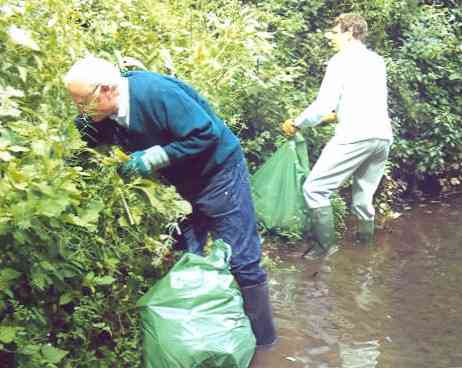
Himalayan Balsam (Impatiens glandulifera) is recognised by the Environment Agency within their published hit list of “top ten invasive species marked for containment and removal". As its name implies, this plant isn’t a native of the UK. It was introduced into the country from India in 1839 by John Forbes Royle and has escaped to colonise riverbanks and other damp ground. The plant has adapted successfully to UK conditions and now out-competes many native British plants, colonising whole watercourses.An annual, it can reach 3m high before the seedpods explode scattering seed over a wide area. With thick, hollow stems and pointed, serrated leaves, it has pretty pink or mauve flowers in June and so can be thought of as an interesting plant.. But it is so invasive that it totally swamps an area leaving no room for anything else – leaving the ground bare in winter. The banks of the Emm Brook are awash with it and FOTEB are trying to eliminate it in order to assist native species. FOTEB undertake an extensive annual clearance on the banks of the Emm this takes place before the seed disperse.
Himalayan Balsam is reputed to be the tallest annual plant in the United Kingdom and spreads rapidly due to its exceptional seed distribution system; it has explosive seed-capsules that propel seeds up to 7m. Plants can to grow up to three metres in height in three months.
Wild Flower Meadow (Riverside Walk)
First we needed to know what already grew in the area so we negotiated with Wokingham Borough Council to leave a large circle of grass un-mown for the spring /summer of 2007. It began well and on the 18th May 2007 Sue Farrington and Doreen Dye recorded 18 species already growing there, and Mike Saynor made some delightful notices to explain our intentions to the public. The grass was cut at the end of July, after seeding and the resulting hay removed.Among the plants recorded in the May survey were Common Mouse Ear (Cerastium fontanum), Sheep Sorrel ( Rumex acetosella), Goose Grass, Cuckoo Flower, and Yorkshire Fog (a grass). Wokingham Borough Council has also agreed after speaking with FOTEB, to change the way in which the grass is mowed at Riverside Walk, the part of the Emm Brook which flows from Meadow Road to Morrissons in Woosehill. By mowing closer to the stream for some short stretches the view of the Brook should be improved for those walking through the park.
Moths
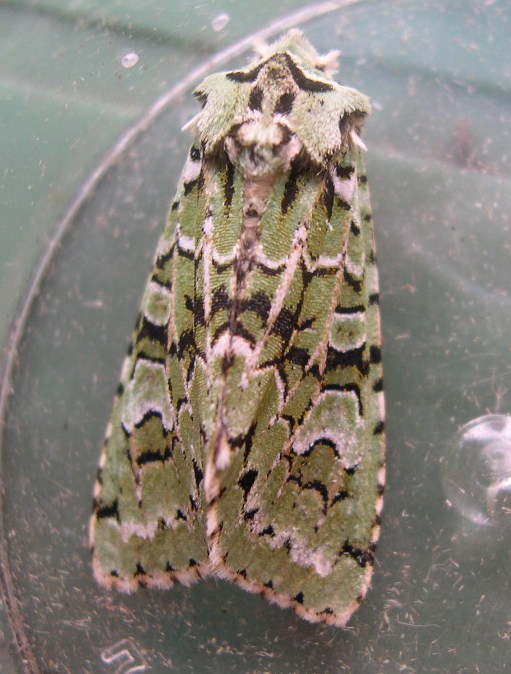
Members of FOTEB have been recording moths in the Riverside Walk area since May 2004 The moths are trapped in a homemade version of a Skinner Trap using either a 125w Mercury Vapour (MV) lamp or a 30w Actinic lamp ( basically a fluorescent tube which operates in the Ultra Violet range). The trap is switched on at dusk and weather permitting switched off again at dawn. The moths collect in and around the trap and the following morning after inspection and recording/photographing are released.More recently a Robinson trap has been used. The list at this time is 406 species of moths.
During this time we have also recorded a 1st for Berkshire in the form of a Cypress Carpet (Thera cupressata). This moth is a recent colonist (first recorded in West Sussex in 1984) and is slowly moving up the country.
FOTEB moth group have also recorded a 2nd for Berkshire with a Rannoch Looper (Itame brunneata) trapped near Riverside Walk on 31st May 2009 . The larva is a Bilberry feeder and is resident in Scotland but only occurs in sounthern England as a rare migrant.. It is believed that this influx probably came from the continent